

Research content
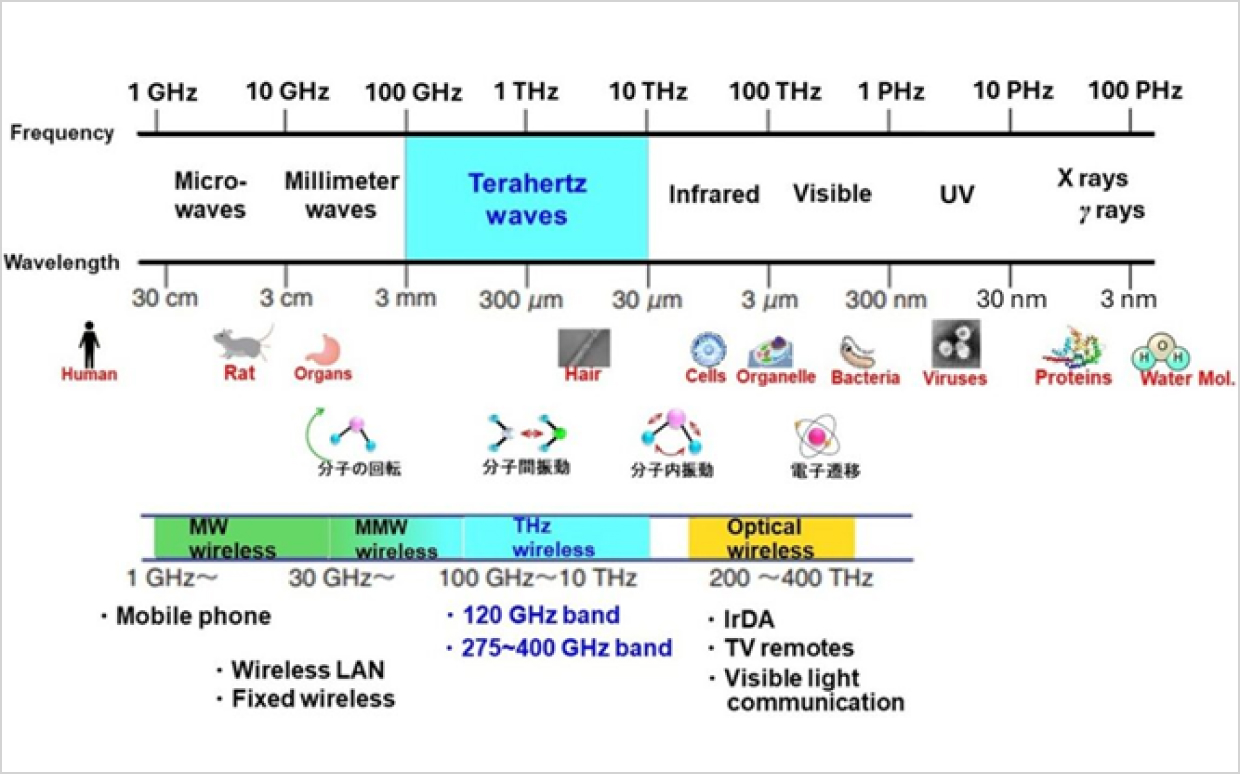
What are terahertz waves?
Terahertz waves are electromagnetic waves with frequencies ranging from about 100 GHz to 10 THz, corresponding to wavelengths between about 30 μm and 3 mm. These waves occupy the intermediate region between radio waves and light.
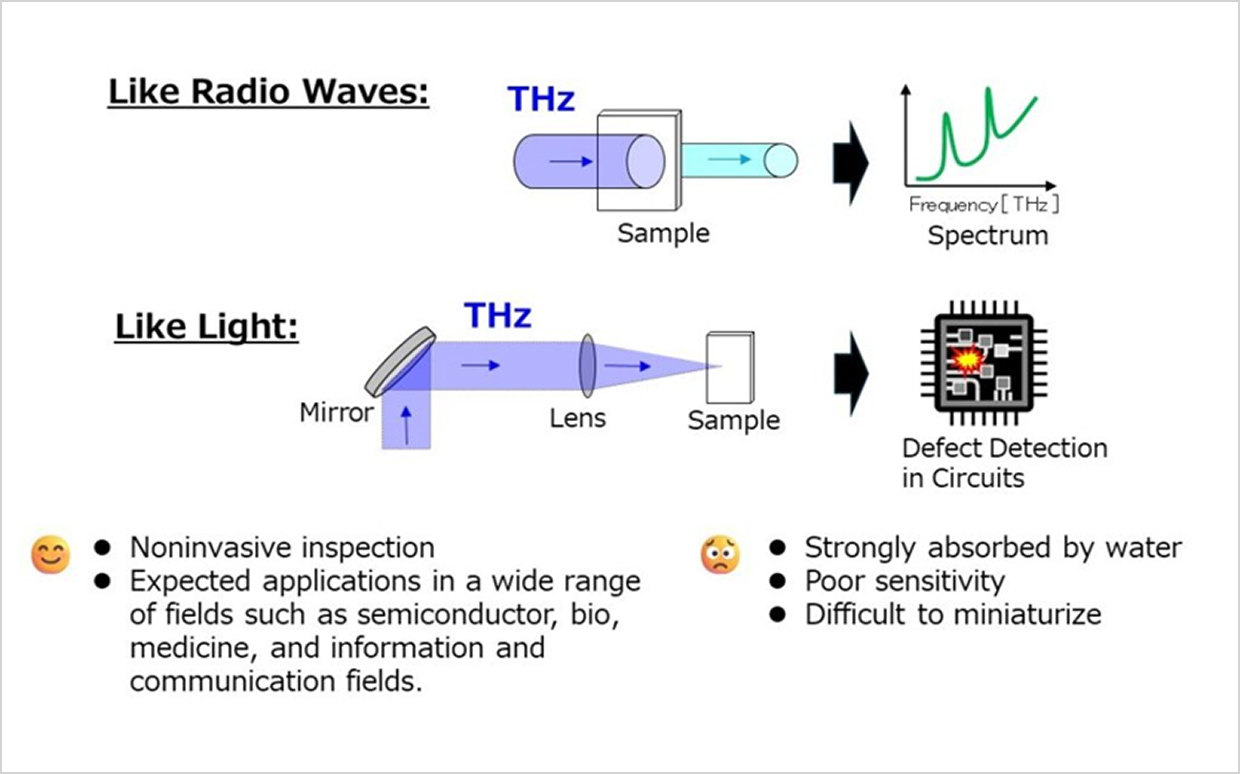
Terahertz waves can penetrate various materials like radio waves, and we can obtain spectral information about the materials. Additionally, like light, they can be reflected and focused using mirrors and lenses, so we can image various materials, too. For example, THz waves can be used to detect defects within semiconductors or identify broken circuits. These capabilities can be utilized non-invasively, so terahertz technology is expected to be applied in various fields.
However, terahertz waves are strongly absorbed by water, resulting in poor sensitivity, which hinders the widespread adoption of practical systems and sensors. At the Serita laboratory, we focus on research utilizing “Point Terahertz Sources” generated through a wavelength conversion process from light to terahertz waves. Our ultimate goal is to create a society where terahertz technology is more accessible and integrated into everyday life.
1.Point Terahertz Sources
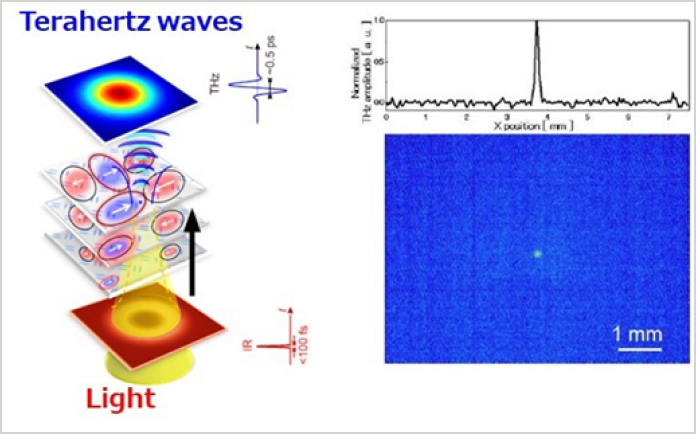
We are developing a highly localized and dense terahertz sources, called “point terahertz sources,” using wavelength conversion of femtosecond pulse lasers. This enables the creation of terahertz sources that are extremely small on the order of micrometers.
For example, a 1 THz wave has a wavelength of about 300 μm and normally cannot be confined to less than half that size (≈150 μm). Our technology, however, creates a point terahertz source nearly 100 times smaller.
2.Terahertz Bio-applications
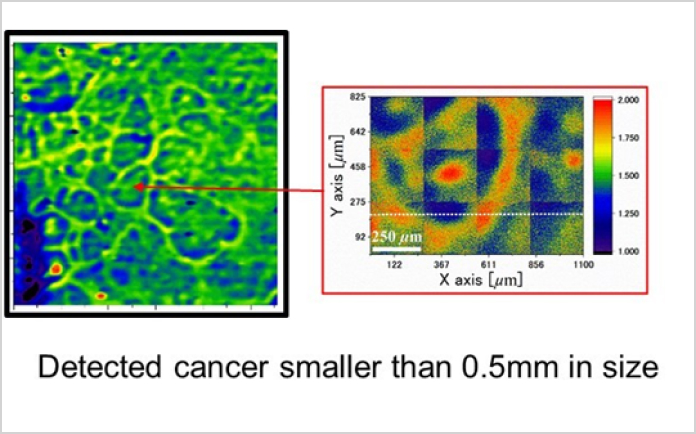
In the terahertz frequency range, unique molecular dynamics such as molecular rotation and intermolecular vibration can be observed, which are not detectable with other electromagnetic waves. These dynamics are believed to play a crucial role in various biological functions, highlighting the importance of developing high-performance systems and sensors.
In this laboratory, we use a new type of terahertz microscope capable of examining small substances such as cells and molecules, as well as biochemical sensors that can detect minute amounts of solution with high sensitivity, to obtain molecular information in the terahertz range. We handle multidimensional and diverse data, including spectroscopic data (1D), imaging data (2D), and structural data (3D).
- See ⇒ Journal of Physics: Photonics 2 (4) 044008 (2020).
- See ⇒ APL Photonics 3 (5) 051603 (2018).
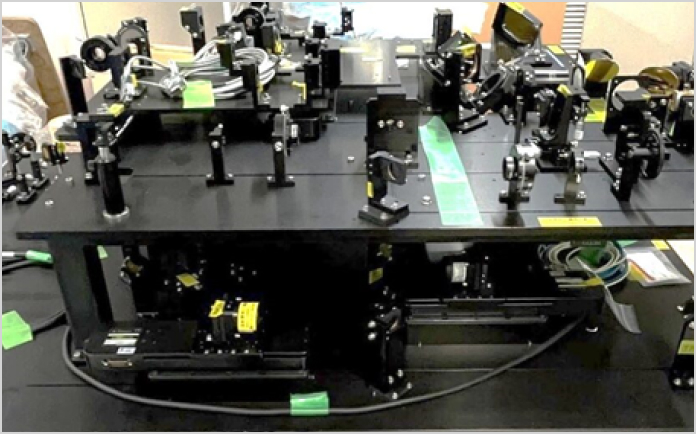
3.Semiconductor Evaluation
We are conducting research on the application of terahertz technology to non-destructive inspection and characterization of defects in semiconductor materials, semiconductor devices, and LSIs. As the semiconductor industry is a hot topic in Kyushu, we are promoting the development of terahertz technology to support its growth.
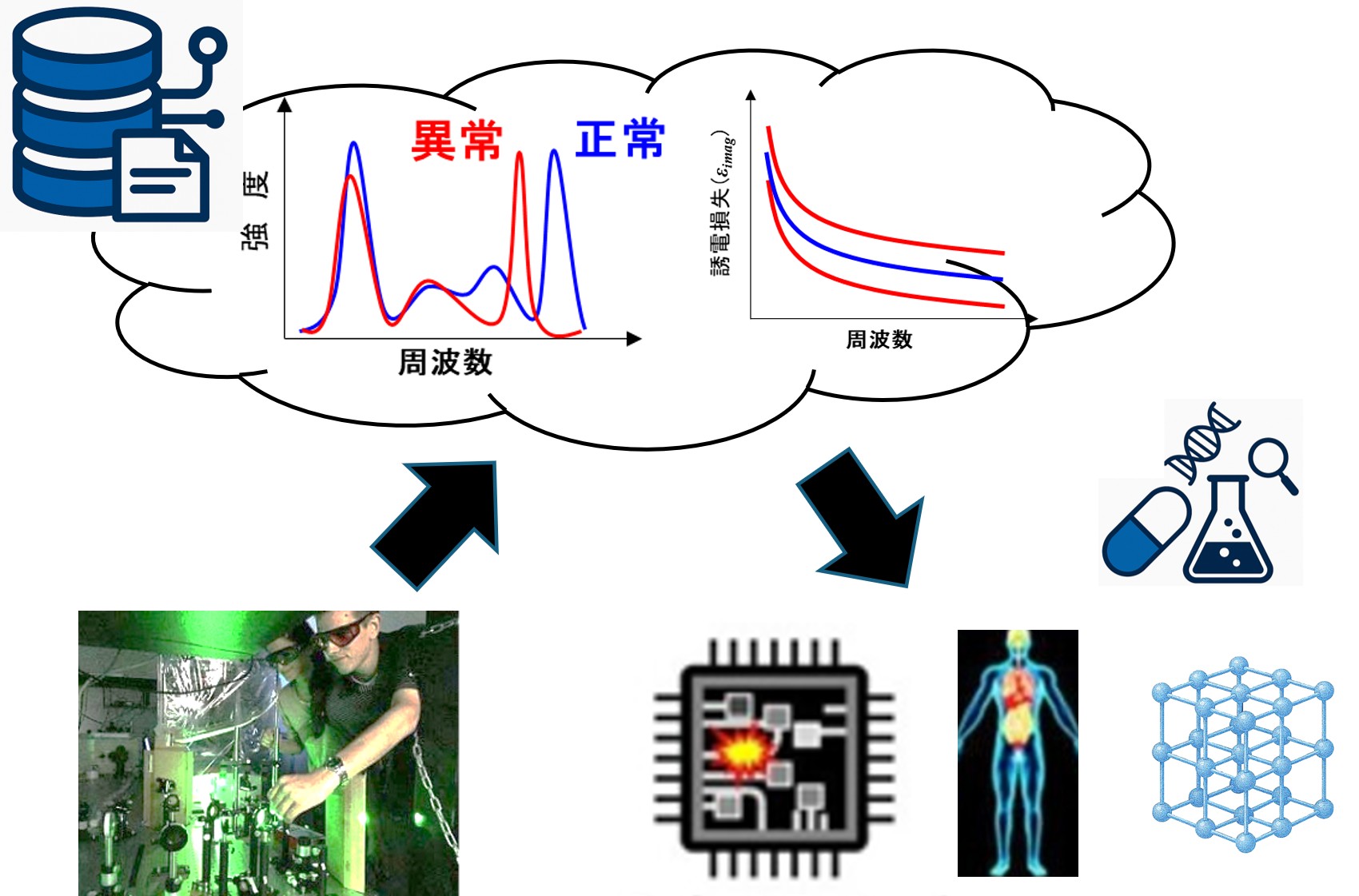 |
4.Development of an Advanced Terahertz Sensing Platform Utilizing ICT We are conducting research that integrates "point terahertz source sensing" with information, AI, and communication technologies to advance the development of imaging and spectral data in the terahertz region. Our goal is to establish a sensing platform capable of early detection of phenomena in which molecular and cellular information in biosensing, as well as local defects, disconnections, and state changes in semiconductor sensing, lead to macroscopic effects in the human body or devices. |
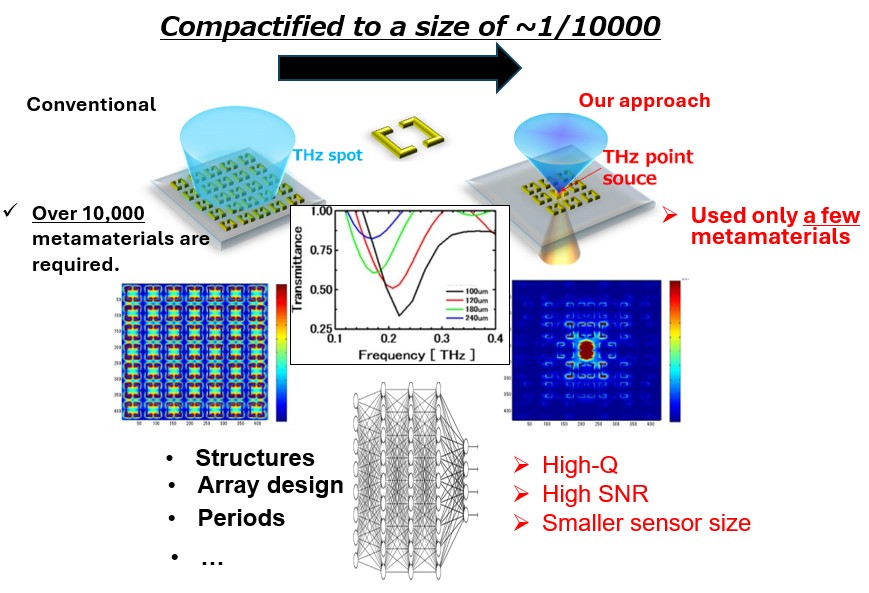 |
5.Development of Compact Terahertz Devices for the Beyond 5G Era We are conducting research on the design of highly sensitive terahertz filters expected to play a key role in the Beyond 5G era, utilizing point terahertz sources. Our approach employs metamaterials—artificially engineered structures—and explores optimal designs using AI by tuning parameters such as geometry, array configuration, and periodicity. This enables the development of compact and highly sensitive terahertz filters. In addition, we are also developing various on-chip and integrated terahertz devices.
See ⇒ Journal of Infrared, Millimeter, and Terahertz Waves 38 (9) 1107-1119 (2017). |
Research Projects
JST FOREST Program
「Development and Application of a Near-Field Terahertz Excitation Probe Microscope for Single-Cell and Single-Molecule Spectroscopic Imaging Analysis」(2020-2027)
【PI:K. Serita】
JSPS KAKENHI Grant-in-Aid for Scientific Research (B)
「Development of High-Resolution Terahertz Endoscopes」(2025-2027)
【PI:K. Serita】
2026 Joint Research Project with Institude of Laser Engineering, Osaka University
「Development of Point Terahertz Sources and Applications in Biosensing」(2026)
【PI:K. Serita】
JSPS KAKENHI Grant-in-Aid for Scientific Research (C)
「Development of an Innovative Diagnostic Technology for Thyroid Tumors Using Terahertz Waves」(2024-2028)
【Co-Investigator:K. Serita(PI:Prof. Masanori Teshima from Kochi University)】
Previous Research Projects
- ・FY2025 Seeds H (Interdisciplinary Research and Development Promotion Support Program) [Kyusyu University], "Development of a Rapid Pathological Diagnostic Device using Terahertz Light,"(2025)【PI:K. Serita】
- ・FY2025 Kitakyushu Foundation for the Advancement of Industry, Science and Technology (FAIS) Research and Development Project Support Program (Seed Creation and Practicality Verification Project) — Young Researcher / Challenge Category, "Development of an AI-Integrated High-Resolution Terahertz Emission Microscope for Non-Destructive Defect Identification in Semiconductors,"(2025)【PI:K. Serita】
- ・2025 Joint Research Project with Institude of Laser Engineering, Osaka University, "Development of Point Terahertz Sources and Applications in Biosensing,"(2025)【PI:K. Serita】
- ・JSPS KAKENHI Grant-in-Aid for Scientific Research (A) , "Photon terahertz wave conversion modeling in local fields and its application to semiconductor analysis ,"(2023-2025)【Co-Investigator:K. Serita(PI:Prof. Masayoshi Tonouchi from Okayama University)】
- ・JSPS KAKENHI Grant-in-Aid for Challenging Research (Pioneering), "Development and Application of a Near-Field Terahertz Microscope Suitable for Cellular Measurements under Physiological Conditions,"(2020-2024)【PI:K. Serita】
- ・JSPS KAKENHI Grant-in-Aid for Scientific Research (B), "Development of highly sensitive terahertz micro-TAS and its applications to the nanobioanalysis,"(2021-2023)【PI:K. Serita】
- ・JST A-STEP FY2020 Additional Call (Tryout Type) – Standard「Development of a Highly Sensitive Terahertz Biosensor Capable of Label-Free Detection of SARS-CoV-2 in Wastewater」(2020)【PI:K. Serita】
- ・JSPS KAKENHI Fund for the Promotion of Joint International Research (Fostering Joint International Research (B)), "Science of local optical-to-terahertz wave conversion in low dimensional nanomaterials,"(2020-2024)【Co-Investigator:K. Serita】
- ・Konica Minolta Science and Technology Foundation, "Development of a Terahertz Spectroscopic Imaging Microscope and Its Application toward On-Site Cytological Diagnosis"【PI: K. Serita】(2020)
- ・JSPS KAKENHI Grant-in-Aid for Scientific Research (B), "Development of Nanobio terahertz measurement platform using local-terahertz-electric-field-enhanced metamaterial chips,"(2018-2020)【PI:K. Serita】
- ・Murata Science and Education Foundation, "Development of a Terahertz μTAS (Micro Total Analysis System)"(2017)【PI:K. Serita】
- ・JSPS KAKENHI Grant-in-Aid for Scientific Research (A), "Development of an ultrahigh sensitivity terahertz biochip,"(2017-2019)【PI:K. Serita】
- ・Nakatani Foundation 技術交流助成(海外派遣)(2016年度第4回)【PI:K. Serita】
- ・JSPS KAKENHI Grant-in-Aid for Young Scientists (B), "Development of highly sensitive near-field terahertz sensors for the measurement of trace amount of solutions,"(2015-2018)【PI:K. Serita】
- ・JSPS KAKENHI Grant-in-Aid for JSPS Fellows, "Development of a scanning laser terahertz near-field imaging system,"(2015-2018)【PI:K. Serita】